


As a supplier of PE corrugated pipes, I've encountered numerous inquiries from clients regarding how pipe length impacts the flow characteristics within these pipes. This topic is crucial as it directly influences the performance and efficiency of various piping systems where PE corrugated pipes are utilized, such as the Drain Line Of Air Conditioner. In this blog post, I'll delve into the scientific aspects of this relationship and share insights based on industry knowledge and research.
Understanding the Basics of Flow in PE Corrugated Pipes
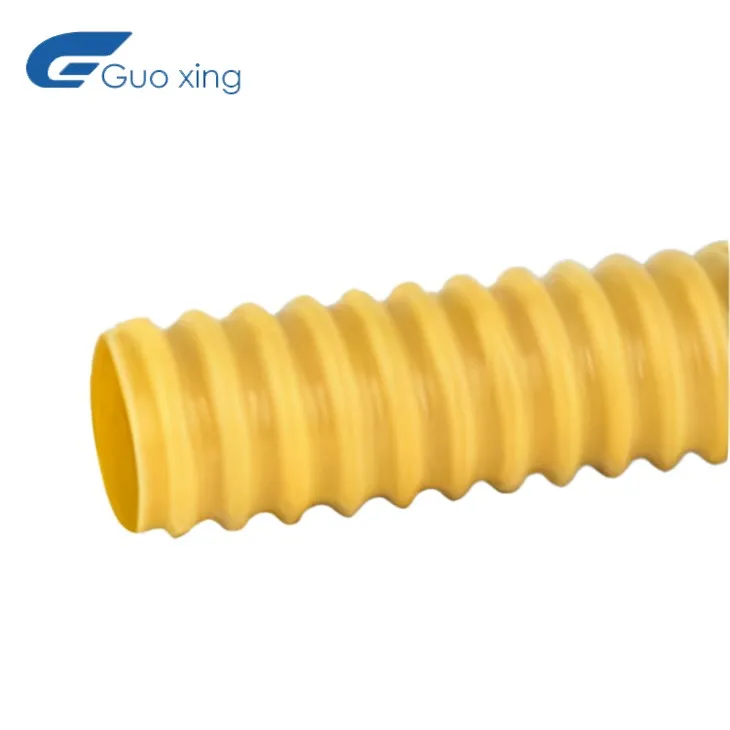
PE corrugated pipes, like PE Corrugated Pipe, are known for their flexibility, durability, and resistance to corrosion. These pipes find wide applications in drainage, ventilation, and cable protection systems. The flow of fluid (usually water or air) through these pipes is a complex phenomenon influenced by several factors including pipe diameter, roughness, fluid viscosity, and of course, pipe length.
In fluid dynamics, the flow through a pipe can be classified into two main types: laminar flow and turbulent flow. Laminar flow occurs at low velocities, where the fluid moves in smooth layers with minimal mixing. Turbulent flow, on the other hand, is characterized by chaotic and irregular fluid motion. The transition from laminar to turbulent flow is determined by the Reynolds number (Re), a dimensionless quantity that accounts for the fluid velocity, density, viscosity, and the pipe diameter.
Effect of Pipe Length on Pressure Drop
One of the most significant effects of pipe length on flow characteristics is the pressure drop. As fluid flows through a pipe, it experiences frictional resistance along the pipe walls. This resistance causes a decrease in pressure as the fluid moves downstream. The longer the pipe, the greater the surface area in contact with the fluid, and thus the higher the frictional resistance and pressure drop.
The pressure drop in a pipe can be calculated using the Darcy - Weisbach equation:
$$\Delta P = f\frac{L}{D}\frac{\rho V^{2}}{2}$$
where $\Delta P$ is the pressure drop, $f$ is the Darcy friction factor, $L$ is the pipe length, $D$ is the pipe diameter, $\rho$ is the fluid density, and $V$ is the average fluid velocity.
From this equation, it's evident that the pressure drop is directly proportional to the pipe length. This means that as the length of the PE corrugated pipe increases, the pressure drop also increases linearly, assuming other factors remain constant. This is a critical consideration in piping systems, as excessive pressure drop can lead to reduced flow rates and inefficient operation.

Impact on Flow Rate
The pressure drop caused by the pipe length has a direct impact on the flow rate. According to the Hagen - Poiseuille's law for laminar flow in a circular pipe, the flow rate ($Q$) is given by:
$$Q=\frac{\pi R^{4}\Delta P}{8\mu L}$$
where $R$ is the pipe radius, $\mu$ is the fluid viscosity, and $\Delta P$ is the pressure drop across the pipe length $L$.
In the case of turbulent flow, the relationship between flow rate, pressure drop, and pipe length is more complex. However, in general, an increase in pipe length leads to an increase in pressure drop, which in turn reduces the flow rate. This is because the fluid has to overcome a greater resistance to flow through a longer pipe.
Influence on Flow Velocity
The flow velocity within the pipe is also affected by the pipe length. As the pressure drop increases with longer pipes, the fluid has less energy available to maintain its velocity. Consequently, the flow velocity decreases as the pipe length increases. This reduction in velocity can have implications for the effectiveness of the piping system, especially in applications where a certain minimum velocity is required to prevent sedimentation or ensure proper mixing.
Case Studies and Real - World Applications
Let's consider a real - world example of a drainage system using PE Corrugated Pipe. In a large commercial building, the drainage pipes need to carry a significant amount of wastewater from various floors to the main sewer line. If the pipes are too long, the pressure drop will be substantial, resulting in a reduced flow rate. This can lead to slow drainage, clogging, and potential flooding in extreme cases.
On the other hand, in a ventilation system, the air flow through the PE corrugated pipes needs to be sufficient to maintain proper air quality. If the pipes are overly long, the pressure drop will cause a decrease in air velocity, reducing the effectiveness of the ventilation system.
Solutions and Considerations
When designing a piping system using PE corrugated pipes, it's essential to carefully consider the pipe length to ensure optimal flow characteristics. Here are some solutions and considerations:
-
Proper Sizing: Choose the appropriate pipe diameter based on the required flow rate and allowable pressure drop. A larger diameter pipe can reduce the frictional resistance and minimize the pressure drop for a given flow rate.
-
Intermediate Connections: For long - distance piping systems, consider installing intermediate connections such as pumps or manifolds to boost the pressure and maintain the flow rate.
-
Pipe Material and Wall Roughness: The roughness of the pipe wall affects the frictional resistance. Smooth - walled PE Extruded Pipe can reduce the pressure drop compared to pipes with a more rough surface.
Conclusion
In conclusion, the length of PE corrugated pipes has a significant impact on the flow characteristics, including pressure drop, flow rate, and flow velocity. As a PE corrugated pipe supplier, I understand the importance of providing accurate information to our clients to help them design and implement efficient piping systems. By considering the effects of pipe length and implementing appropriate solutions, we can ensure that the piping systems meet the required performance standards.
If you're in the market for high - quality PE corrugated pipes or need more information on how to optimize your piping system design, feel free to contact us. We're here to assist you in making the right choices for your project.
References
- White, F. M. (2016). Fluid Mechanics. McGraw - Hill Education.
- Moody, L. F. (1944). Friction factors for pipe flow. Transactions of the American Society of Mechanical Engineers, 66(8), 671 - 684.


